



Table of Contents
ToggleCall of Duty has dominated the gaming landscape for over two decades, but behind every blockbuster release lies a critical piece of marketing strategy: the cover art. These covers aren’t just packaging, they’re the first visual touchpoint that captures the essence of each game’s campaign, setting, and tone. From the gritty, photo-realistic soldiers of the early 2000s to the stylized, cinematic designs of today, Call of Duty’s cover art has evolved dramatically, reflecting both advances in design technology and shifts in what resonates with players. Whether you’re a collector hunting steelbook editions or simply curious about how Activision has positioned its flagship franchise visually, understanding this evolution reveals how a single image can telegraph a game’s identity and influence fan expectations before a single shot is fired.
Key Takeaways
- Call of Duty cover art has evolved from grounded WWII photorealism to cinematic, character-driven designs that communicate campaign narrative and emotional tone before players even start the game.
- Modern Warfare’s 2007 revolution shifted cover design strategy from generic soldier portraits to intimate, tactical character focus, establishing the visual language that defined the franchise’s prestige for over a decade.
- Black Ops pioneered psychological visual storytelling through desaturated, fragmented imagery and mysterious compositions, while Modern Warfare maintained clean, professional tactical aesthetics—a visual distinction that became industry-noteworthy.
- Contemporary Call of Duty cover art balances heritage authenticity with platform adaptability, incorporating augmented reality elements, variable editions, and regional customization while maintaining iconic design principles across console, PC, and digital storefronts.
- Iconic covers like Modern Warfare 2’s masked operator and Black Ops’ haunting protagonist achieve legendary status through emotional authenticity, visual restraint, and cultural timing that resonate with players long after launch.
- Steelbook collector editions represent the premium apex of cover art presentation, employing metallurgical printing techniques, embossing, and lenticular effects that create tactile, three-dimensional visual experiences unavailable in standard packaging.
The Early Era: Establishing Call of Duty’s Visual Identity (2003-2008)
Original Call of Duty and United Offensive
When the original Call of Duty launched in October 2003, the cover art set a grounded, military-authentic tone that would define the franchise for years. The cover featured a soldier in period-accurate World War II gear, depicted with the photorealism and texture detail that were cutting-edge for the era. There was no bombastic explosion, no heavily stylized composition, just a frontline infantryman ready for combat. This restraint worked brilliantly because it communicated exactly what the game delivered: an immersive, boots-on-the-ground WWII experience.
United Offensive (2004), the expansion pack, followed suit with a similar aesthetic. The cover maintained that documentary-style presentation, emphasizing authenticity over spectacle. These early designs established a foundational principle: the cover should reflect the game’s promise to players. In this case, it was fidelity to historical warfare and squad-based gameplay.
The color grading in these original covers leaned toward desaturated, naturalistic tones, browns, grays, and muted greens. This palette choice directly influenced how players perceived the game before even opening the box. There was no glossy, hyperpolished look: instead, the covers felt tactile and rugged, matching the gritty campaign experience.
Modern Warfare Series Foundation
By 2007, Call of Duty 4: Modern Warfare shifted everything. The cover art moved from historical WWII to a contemporary military setting, but more importantly, it introduced a dynamic compositional approach. Rather than a single soldier portrait, Modern Warfare’s cover featured protagonist Gary Sanderson in a more action-oriented pose, often with environmental context suggesting immediate combat.
This was a critical turning point. The design signaled to players that this wasn’t another historical shooter, it was now, it was urgent, and it was cinematic. The color palette remained grounded but became slightly more stylized, with warmer tungsten lighting that suggested urban environments and interior spaces rather than open battlefields.
Modern Warfare’s cover design also introduced tighter focus on individual characters. Where early CoD covers showed soldiers more generically, Modern Warfare put faces front and center, sometimes obscured by tactical gear, sometimes barely visible in shadow. This character-driven approach foreshadowed a major shift in how the franchise would market its narratives going forward.
The Modern Warfare Revolution and Peak Influence (2007-2013)
How Modern Warfare Changed Cover Art Strategy
The release of Modern Warfare 2 (2009) and Modern Warfare 3 (2011) represented the franchise’s visual design at maximum commercial confidence. These covers became more cinematic, more dramatic, and increasingly photorealistic thanks to advances in photography and retouching technology. The covers moved beyond static soldier portraits into dynamic, almost action-movie compositions.
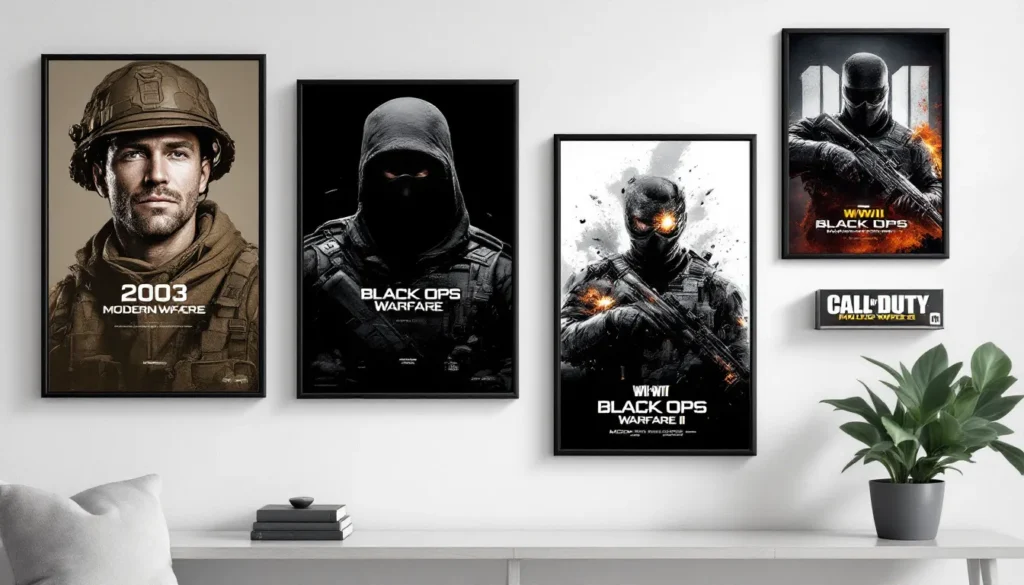
Modern Warfare 2’s cover, often featuring a masked operator or high-intensity tactical scenario, became one of the franchise’s most recognizable images. It wasn’t just a game cover, it was aspirational visual fantasy. The design communicated: This is serious. This is professional. This is elite. The black masks, tactical vests, and high-contrast lighting became shorthand for premium Call of Duty.
What made Modern Warfare’s approach revolutionary was its understanding of franchise positioning. While competitors like Battlefield leaned into large-scale destruction and panoramic landscapes, Call of Duty’s covers stayed intimate, focused, and character-centric. This tighter framing made the covers feel more personal, more heroic. A single operator’s eyes or jaw line could carry narrative weight that sprawling battlefield scenes couldn’t.
During this period, Activision also began regionalizing covers. North American, European, and Asian releases sometimes featured different artwork or character focus, recognizing that visual preferences varied globally. This sophisticated marketing approach elevated cover art from afterthought to core brand asset.
Character-Driven Designs and Narrative Focus
By the early 2010s, Call of Duty covers had become deeply tied to campaign narrative. Black Ops (2010) featured Alex Mason, and the cover communicated his psychological fragility through desaturation and a tighter crop. Modern Warfare 3 emphasized Task Force 141, with multiple characters or heavy focus on protagonist Yuri. These weren’t just marketing images, they were visual encapsulations of the campaign’s emotional arc.
This narrative integration became a franchise hallmark. Unlike many shooters that treated cover art as generic marketing, Call of Duty used covers to build anticipation for story beats. Players entering a game with Call Of Duty cover art already loaded with character and emotional context felt more invested in the campaign before hitting play.
The lighting techniques during this era grew increasingly sophisticated. Photographers and retouchers used dramatic side-lighting, volumetric effects, and high-contrast ratios to create depth. Tactical gear received meticulous detail, you could see fabric texture, weathering, and worn patches that communicated a soldier who’d seen action. This hyper-realism extended brand prestige and justified the $60 price point in a visual medium.
Design Trends: From Gritty Realism to Dynamic Composition (2009-2016)
The Black Ops Aesthetic and Darker Palettes
The Black Ops franchise carved its own visual identity, distinct from Modern Warfare even though sharing the same DNA. While Modern Warfare covers emphasized clean, tactical professionalism, Black Ops embraced psychological darkness. The color palette shifted dramatically toward desaturated, near-monochromatic designs with occasional bold accent colors, blood reds, neon blues, or sickly greens.
These covers communicated a thematic departure. Black Ops campaigns dealt with mind control, conspiracy, and moral ambiguity. The visual design reflected that. Characters looked haunted or fractured. Some covers incorporated distorted imagery, glitch effects, or layered compositions that suggested fragmented narratives or unreliable perception.
Black Ops 2 (2012) took this further, using split-screen or dual-focus compositions that hinted at time-jumping campaigns and multiple protagonist timelines. The cover wasn’t just showing a soldier, it was showing narrative complexity. Gamers recognized that they weren’t getting a straightforward military story: they were getting something weirder, deeper, more psychologically engaging.
The visual distinction between Modern Warfare and Black Ops became industry-noteworthy. Competitors and analysts pointed to these cover designs as evidence that Activision understood brand architecture and subdivision. Players could distinguish between franchises at a glance. For a publisher pushing multiple Call of Duty entries annually at franchise’s peak, this visual differentiation was crucial marketing.
Visual Themes and Recurring Design Elements
Across the 2009-2016 period, certain design motifs became recurring. Facial obscuration, masks, shadows, aviators, or tactical gear obscuring identity, became increasingly common. This wasn’t laziness: it was a sophisticated design choice that communicated professionalism and tactical expertise. A faceless operator suggested someone so competent that their identity was secondary to their function.
Weather and environmental atmosphere also became a design tool. Modern Warfare covers often featured warm, urban lighting or cold, stark interiors. Black Ops covers incorporated fog, rain, or harsh backlight that suggested mystery or danger. The environment wasn’t just backdrop: it was narrative context that communicated campaign setting and tone.
Color symbolism became deliberate. Warm tones suggested confidence and action. Cool tones suggested doubt and intrigue. Desaturation suggested moral complexity or psychological trauma. Players developed visual literacy around these codes, making cover design increasingly sophisticated as a marketing language. The covers weren’t just pretty, they were communicative, teaching players what to expect tonally before they booted the game.
Modern Era: Balancing Heritage With Innovation (2016-2026)
Infinite Warfare, WWII, and Stylistic Experimentation
The period from 2016 onward brought stylistic diversity that reflected Activision testing different franchise directions. Infinite Warfare (2016) took an unexpected turn, moving gameplay to space warfare. The cover design had to reconcile players’ expectations for modern-military boots-on-ground gameplay with a radically different setting.
Infinite Warfare’s cover featured protagonist Nick Reyes in futuristic tactical gear, often with space-based backgrounds or sci-fi weaponry visible. The design took risks, neon elements, sleeker gear, more stylized lighting, that diverged from franchise convention. Some players embraced the visual audacity: others found it alienating. This division in player reception made Infinite Warfare’s cover design historically significant: it proved that franchise legacy images couldn’t carry games on visual prestige alone.
That same year, Activision learned a lesson. Call of Duty: WWII (2017) marked a return to historical setting, and the cover art reflected a conscious decision to return to grounded authenticity. The cover featured period-accurate uniforms, naturalistic lighting, and gritty environmental context. It was a visual reset, a regression to what had worked for decades. And critically, it worked commercially. The return to WWII, visually telegraphed by cover art that evoked the franchise’s roots, resonated strongly with players fatigued by futuristic settings.
WWII’s cover design also refined photorealism techniques. By 2017, digital retouching had advanced such that covers were virtually indistinguishable from high-end period photography. The textures of wool uniforms, the weathering of leather gear, the authenticity of facial detail reached almost uncanny heights. These covers looked like museum-quality military portrait photography, which was exactly the brand position Activision wanted to project.
The Cold War and Warzone Aesthetic Shift
Black Ops Cold War (2020) brought another stylistic shift, and its cover design reflected contemporary design trends beyond gaming. The covers incorporated more graphic design elements, slightly more stylization, and references to 1980s aesthetics. The cold war setting allowed for period-authentic color grading, warmer, slightly grainy film stock appearance that evoked declassified intelligence photography.
Cold War also marked the integration of 4K Ultra HD visual standards. Cover art became optimized for digital and physical display at much higher resolution, with textures and details visible at massive scale. This mattered for Steelbook editions and deluxe packaging, the cover had to hold up visually when blown up to poster size.
More significantly, Cold War’s cover design reflected the franchise’s shift toward live-service integration. The covers had to work across console generations (PS4/PS5, Xbox One/Series X), with optimizations for each. The design had to be universal enough to market the game broadly while sophisticated enough to justify the visual prestige expected at the franchise’s tier.
The rise of Warzone as a cultural force also influenced cover design strategy. Battle royale gameplay didn’t fit the traditional character-centric narrative focus that campaign covers relied on. Warzone’s marketing visuals had to suggest squad dynamics, operator variety, and lived-in tactical environments rather than singular protagonist heroism.
Contemporary Covers: 2024-2026 Releases
As of March 2026, Call of Duty cover design has become increasingly flexible and platform-aware. Modern releases like Modern Warfare III (2023) brought a return to the franchise’s most successful naming, and the cover design capitalized on that legacy while introducing contemporary visual language.
2024-2026 covers incorporate elements that older designs couldn’t: augmented reality QR codes linking to exclusive content, variable artwork for digital versus physical editions, and platform-specific optimizations. The digital storefront version of a cover might feature animated elements or subtle motion that the physical Steelbook cannot.
Contemporary color grading has shifted slightly toward desaturated, almost film-noir palettes on some releases, while others embrace bold accent colors reflecting in-game cosmetic aesthetics. The designs have to work across console, PC, and mobile platforms, each with different display ratios and resolutions. This technical constraint has actually refined design focus, covers that work across all contexts tend to be cleaner, more compositionally balanced, and more iconic.
Recent releases also reflect player diversity more explicitly. While early covers featured predominantly male protagonists, contemporary covers show more varied operator aesthetics and face representation, reflecting both franchise inclusivity efforts and player base demographics that purchasing teams now track quantitatively.
Design Philosophy and Creative Storytelling Behind the Covers
Key Visual Strategies: What Makes Call of Duty Covers Stand Out
Activision’s design teams employ a consistent set of visual strategies that have evolved over two decades. The first is hierarchical focus: the cover immediately communicates what players should look at. Whether through depth of field, lighting contrast, or compositional centering, Call of Duty covers guide the eye with military precision. Nothing feels accidental. Every element reinforces focus on the protagonist or central conflict.
The second strategy is authentic tactical detail. Unlike games that stylize military gear, Call of Duty covers obsess over accuracy. Patch placement, fabric texture, gear weathering, and weapon detail are researched and rendered meticulously. This authenticity builds player trust. If the cover shows a soldier who looks like he’s actually been in combat, players believe the campaign will deliver authentic military experience.
Third is emotional resonance through environment. A cover isn’t just a character portrait, it’s a character in context. Modern Warfare characters exist in urban tactical environments. Black Ops characters emerge from shadow and fog. WWII characters stand in period-accurate settings. The environment communicates emotional and thematic context that a headshot alone couldn’t convey.
Fourth is color psychology applied deliberately. Warm tones suggest action and confidence. Cool tones suggest danger and intrigue. Desaturation suggests moral complexity. Vivid accent colors draw attention to narrative-critical details. These choices aren’t made arbitrarily: they’re informed by player research about what colors and tonal combinations most effectively communicate game themes.
Finally, asymmetrical composition has become increasingly important. Rather than centered, symmetrical character portraits, contemporary covers often position elements off-center, creating dynamic tension. This asymmetry makes covers feel more cinematic and engaging than symmetrical alternatives, even if the composition is more complex.
How Cover Art Reflects Campaign Storylines and Settings
Call of Duty’s cover art functions as visual storytelling before players experience the narrative. The cover for Black Ops communicated psychological trauma through desaturated, fragmented imagery before players encountered mind-control plot devices. Modern Warfare 2‘s cover of a masked Task Force 141 operative communicated elite specialization before players experienced shadow ops and morally questionable missions.
Setting is equally important. WWII covers featured period-accurate uniforms, vehicles, and geography before gameplay revealed campaign theaters. Cold War covers incorporated period film stock aesthetics and 1980s visual language that contextualized the campaign before tutorial missions started. This front-loaded narrative communication is crucial for establishing player expectations and emotional investment.
Recent campaigns have become more interconnected, and covers reflect that. Modern Warfare (2019) and its sequel established shared universe visual language. Operators, gear, and environmental aesthetics remained consistent across covers. Players recognized they were entering a cohesive world, not isolated campaigns. This visual consistency built franchise coherence that transcended individual game releases.
Covers also telegraph campaign emotional arcs. A cover showing a character in shadow and distress suggests a campaign involving moral compromise or psychological deterioration. A cover showing confident tactical positioning suggests straightforward military objectives and power fantasy. These visual promises influence how players engage with campaign narratives before experiencing a single cutscene. The cover becomes the first chapter of the story.
Collector’s Editions and Special Variants: Premium Visual Treatments
Steelbook and Deluxe Edition Cover Designs
For serious collectors, Call of Duty Steelbook editions represent the apex of cover art presentation. These metal cases, first introduced during Modern Warfare’s era, receive custom artwork distinct from standard packaging. Steelbook covers often feature metallurgical color techniques, foil stamping, embossing, and multi-layer printing that physical paper cases cannot achieve.
The design philosophy for Steelbooks differs fundamentally from standard covers. Because the metal substrate has different reflectivity and durability, colors need different calibration. Steelbook designs often embrace bolder, more saturated colors knowing the metal will interact with the printed image. Matte finishes prevent glare but reduce detail visibility. Gloss finishes enhance detail but introduce light artifacts. Premium Steelbook editions strategically combine finishes, gloss for character focus, matte for background detail, creating visual depth impossible on standard paper.
Deluxe editions have similarly received specialized attention. Some deluxe boxes include multiple cover options, allowing collectors to choose aesthetic preference. Others feature lenticular printing, covers that shift imagery when viewed from different angles, adding interactive visual storytelling beyond static images.
Recent Steelbook editions for 2023-2026 releases have incorporated embossing techniques that create three-dimensional texture visible even in digital photography. When photographed for review sites or unboxing videos, these editions showcase tactile quality that elevates perceived value beyond digital-only editions.
Regional Variations and Alternate Artwork
Activision has long recognized that visual preferences vary by region. Japanese releases, for example, often feature more stylized, almost anime-influenced cover designs compared to Western equivalents. Chinese and Korean releases receive customized artwork reflecting local operator aesthetics and character representation priorities.
These regional variations aren’t simple localizations, they’re distinct creative undertakings. A Japanese Steelbook for Cold War featured entirely different composition, color grading, and operator selection compared to North American equivalents. This level of regional customization reflects the franchise’s global marketing sophistication and recognition that cover art communicates differently across cultures.
Some regional releases have become collector’s items precisely because of unique artwork. European releases sometimes featured promotional partner branding (retailer-exclusive covers) that created variant scarcity. Players in secondary markets actively traded region-specific covers, creating secondary collector value that drove premium pricing for certain variant editions.
Alternate artwork has also emerged through retail partnerships. Best Buy, GameStop, and other retailers occasionally secured exclusive cover variants featuring different compositions or special packaging. These partnership editions forced collectors to choose between gameplay platform optimization (which retailer had the best deal) and visual preference. The fragmentation created artificial scarcity and collectibility that extended franchise relevance beyond launch periods.
With digital editions becoming increasingly standard by 2024-2026, physical cover variants became rarer and more valuable to collectors. Limited print runs for Steelbook editions, in particular, created speculation markets where certain variants appreciated in value based on scarcity, design quality, and franchise significance. What began as packaging became investment-tier collectible merchandise.
Fan Favorites and Most Iconic Call of Duty Covers Ranked
The Community’s Top-Tier Designs
Among the Call of Duty fanbase, certain covers achieve legendary status through a combination of visual quality, cultural timing, and franchise significance. Modern Warfare 2‘s cover featuring the masked operator remains at the apex for most veteran players. That image, black tactical gear, obscured face, cold lighting, became synonymous with peak franchise prestige during the Xbox 360/PS3 generation. When players think “classic Call of Duty,” many default to that visual.
Black Ops‘ haunting, desaturated cover of Alex Mason ranks extraordinarily high in community appreciation. The psychological fragmenting of the image, combined with the raw intensity of Mason’s gaze, communicated character depth that carried through the campaign. Players who experienced Black Ops as teenagers recall that cover as iconic to their gaming identity.
Black Ops 2 represents another high-tier design, with its split-temporal composition and dual-protagonist framing. The cover visually promised the complex narrative delivered, and the design sophistication resonated with players tired of simpler visual language from competing franchises.
WWII earns respect from collectors and historical authenticity enthusiasts. The cover’s return to period-accurate military aesthetic, combined with meticulous texture work and naturalistic lighting, represents the franchise at maximum technical realism. For players who grew up with early Call of Duty’s WWII grounding, the visual nostalgia combined with contemporary technical polish hit an emotional target.
Infinite Warfare occupies a unique space: visually striking and divisive. While commercial reception was mixed, the cover design itself earns acknowledgment for aesthetic ambition. The sci-fi elements, neon touches, and willingness to diverge from military convention represented design risk-taking that some collectors specifically appreciate as a moment of franchise experimentation.
Why Certain Covers Resonate With Players
There are recurring themes in why certain covers achieve iconic status. Emotional authenticity matters enormously. Covers that show characters looking genuinely haunted, determined, or conflicted perform better in player memory than covers with generic tactical poses. Modern Warfare 2’s masked operator works because the composition suggests psychological complexity even through obscured features. Black Ops’ Alex Mason works because his eyes communicate character depth.
Visual restraint also drives appreciation. While elaborate composition and dynamic elements matter, some of the most fondly remembered covers achieve impact through subtlety. A single character, tight framing, and strategic use of negative space often outperform information-heavy designs. This applies across gaming and film marketing, the most iconic images tend toward minimalism that forces viewers to interpret meaning rather than digest busy visual information.
Franchise moment alignment explains why certain covers become embedded in player memory. Modern Warfare 2’s cover launched during peak franchise momentum, maximum cultural relevance for competitive gaming, and the height of console generation. The cover benefited from being the visual symbol of gaming’s biggest moment. Black Ops 2 similarly aligned with franchise visibility and institutional cultural status. Covers from commercially successful periods gain mythological status through association with peak franchise experience.
Technical quality at release date also matters in retrospective appreciation. Early covers that look photorealistic for 2007 feel less impressive by 2026. But covers that achieved cutting-edge photorealism for their era and aged gracefully receive respect. WWII’s cover, because it used period-authentic techniques and naturalistic grading, hasn’t felt dated the way some 2015-era covers with trendy color grading have. Timeless visual approach beats trend-chasing.
Finally, meme-ability and cultural osmosis played roles players don’t always consciously acknowledge. Certain covers became so recognizable that gaming communities remixed, referenced, and celebrated them beyond the game’s original launch window. This cultural staying power isn’t accidental, it flows from covers that communicate clearly, memorably, and in ways that invite interpretation and iteration. The best Call of Duty cover designs become visual touchstones precisely because they work across multiple engagement levels: as marketing, as art, as design achievement, and as cultural meme.
Conclusion
Call of Duty cover art represents two decades of evolution in game marketing design, reflecting technological advancement, shifting player expectations, and franchise maturation. From the grounded authenticity of early WWII covers through Modern Warfare’s cinematic revolution, the psychological darkness of Black Ops, and contemporary experimentation with stylized composition, each era’s cover design communicated exactly what that franchise moment promised.
These covers matter because they’re the first visual contract between players and developers. They telegraph narrative tone, setting authenticity, character investment, and emotional complexity before a single gameplay second elapses. The most successful Call of Duty covers, Modern Warfare 2’s masked operator, Black Ops’ fractured protagonist, WWII’s period authenticity, succeed because they deliver on that visual promise through campaign experience.
As the franchise enters 2026 and beyond, cover design will continue evolving. Digital editions reduce the necessity of physical packaging, but limited Steelbook runs and collector consciousness ensure that cover art remains culturally significant. Regional variations will persist. Stylistic experimentation will continue. But the fundamental principle Activision established decades ago remains constant: the cover is the game’s first storyteller. It sets expectations, builds anticipation, and creates the visual identity that players associate with their campaign experience for years after launch.
For collectors, casual players, and franchise historians, studying Call of Duty covers provides insight into how visual marketing, technical capability, and creative vision intersect to build cultural products. The covers themselves have become artifacts worthy of appreciation independent of the games they advertise, a testament to the design sophistication that AAA franchises now demand.